

Time to complete: 10 minutesDifficulty: BeginnerPrerequisites: Google Sheets or Excel connectionYou’ll build: An agent that scrapes product data and formats it for Shopify import
Why Automate This?
The Problem: E-commerce teams manually browse supplier websites, copy product details into spreadsheets, and reformat data for Shopify import. This process takes hours, is prone to errors, and needs to be repeated whenever suppliers update their catalog. Missing a new product or price change means lost sales. The Solution: A Duvo agent that automatically browses supplier websites, extracts product information, and formats it into a Shopify-compatible feed—ready to import or sync with your store. Expected Results:- Reduce catalog updates from hours to minutes
- Eliminate manual copy-paste errors
- Catch new products and price changes automatically
- Maintain consistent data formatting for Shopify
- Schedule regular updates to keep catalog current
What You’ll Build
By the end of this tutorial, you’ll have an agent that:- Navigates to a supplier website
- Extracts product details (name, price, SKU, description, images)
- Formats data into Shopify’s required CSV structure
- Outputs to Google Sheets or Excel for import
Before You Start
Make sure you have these ready:Google Sheets or Excel connection - For storing the formatted feed. Add a connection
Supplier website URL - The website you want to scrape
Shopify import format (optional) - Upload to Files for reference
Create Your Agent
- Click ”+ Create Agent” from your dashboard
- Select “Use Agent Builder” (recommended for this tutorial)
Describe Your Workflow
Paste this prompt into the Agent Builder (modify the URL for your supplier):Click “Generate” to create the agent AOP.
Review Generated AOP
Review to ensure:
- The correct website URL is specified
- All product fields you need are captured
- Shopify column mapping is correct for your store
Configure Connections
Click “Connections” and connect:
- Google Sheets or Excel - For outputting the formatted feed
Run Your Agent
- Click “Run Agent”
- Watch as the agent browses the supplier website
- View the extracted products in real-time
- Is the agent finding all products?
- Are prices being extracted correctly?
- Are images being captured?
Review Your Feed
Once complete, check your Google Sheet: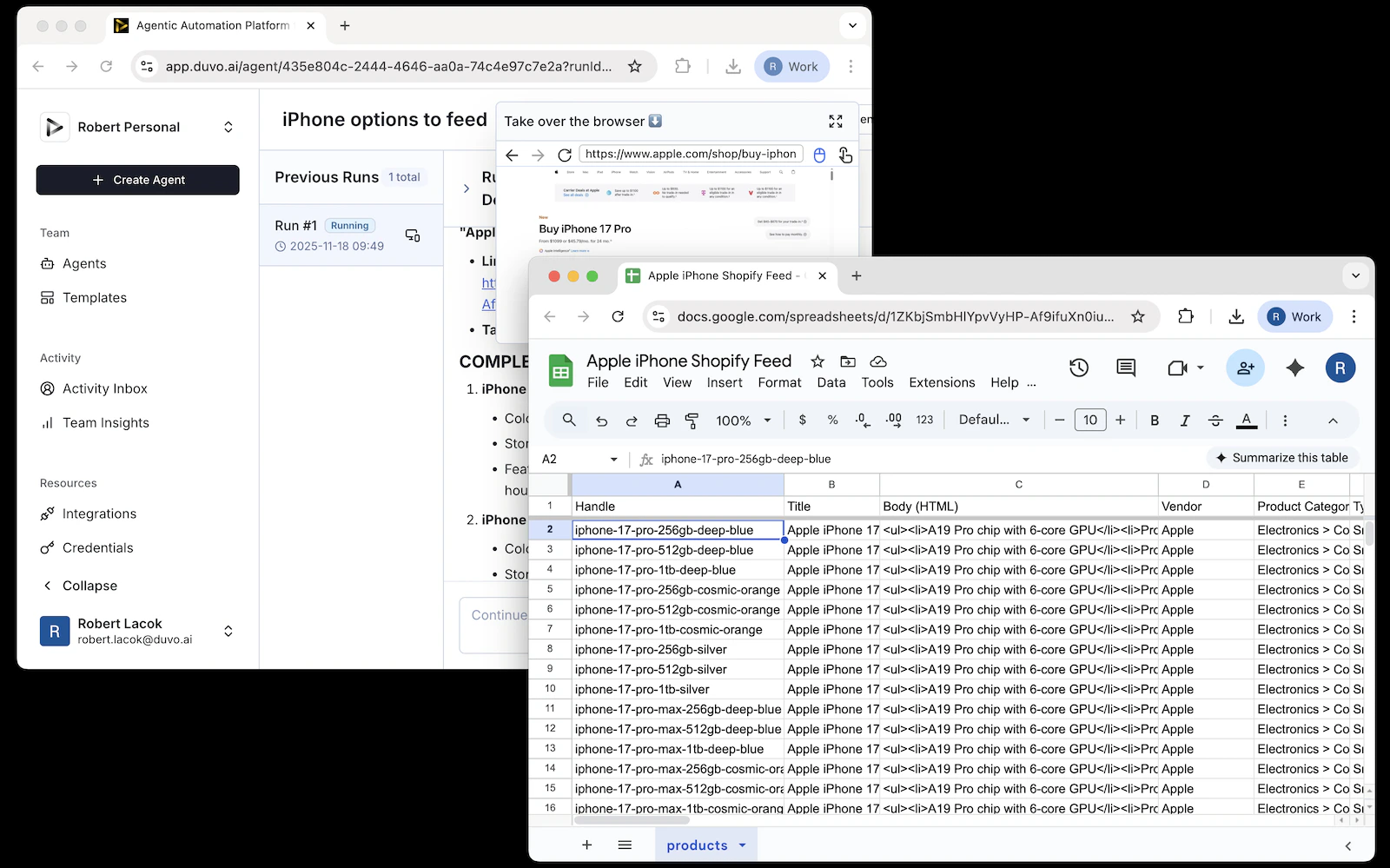
- Verify all products were captured
- Check that formatting matches Shopify requirements
- Validate prices and variants are correct
Expected Results
When your agent runs successfully, you should see: In Google Sheets/Excel:- Complete product catalog with all variants
- Properly formatted for Shopify import
- Consistent SKU generation
- All image URLs captured
- Download as CSV
- Import directly into Shopify Admin
- Or connect via API for automatic sync
- Complete log of pages visited
- Count of products extracted
- Any errors or missing data flagged
Troubleshooting
Products not being found
Products not being found
- Page structure: Website may have changed—update your AOP
- Dynamic loading: Some sites require scrolling to load products
- Login required: Some supplier sites need authentication
Prices incorrect
Prices incorrect
- Currency symbols: Ensure agent is extracting numeric values only
- Sale prices: Specify whether to capture regular or sale price
- Regional pricing: Check if site is showing correct region’s prices
Missing images
Missing images
- Lazy loading: Images may need page scroll to load
- Multiple images: Specify if you want primary image only or all images
- Image size: Request specific image sizes if available
Formatting issues
Formatting issues
- Special characters: Product names may have characters that need escaping
- HTML in descriptions: Ensure proper HTML formatting for Shopify
- Variant structure: Verify Option1/Option2 mapping matches your store
Take It Further
Once your basic agent is working, consider these enhancements:Add multiple suppliers
Add multiple suppliers
Schedule regular updates
Schedule regular updates
Add inventory tracking
Add inventory tracking
Enrich with SEO data
Enrich with SEO data
Add competitor price monitoring
Add competitor price monitoring
Related Resources
Browsing Capabilities
How Duvo navigates websites
Files
Upload Shopify format templates
Connections Overview
Connect spreadsheet apps